 Cheongdam · Seoul clinic
BLS Clinic Main Branch
BLS Main Branch offers lifting, laser treatment, skin boosters, hair removal and facial volume procedures at its Dosan-daero location. The breadth of its menu makes a…
Explore clinic ↗Promoted
How to plan consultation, recovery, review and care after returning home without squeezing a treatment course into a holiday.
A short stay in Seoul may leave enough time for an assessment, but it does not automatically leave enough time for a procedure and its follow-up. The useful question is not simply whether a treatment can be completed in an hour. It is whether the proposed care, recovery and review can fit safely within your actual itinerary. Tell the clinic your arrival and departure dates before choosing a package, and keep the option of consultation without treatment open.
This guide is a planning framework, not a universal recovery calendar. The right schedule depends on the procedure, its intensity, your medical history and the clinician's assessment. A surface treatment, an injection and an ablative resurfacing procedure have different requirements. Even people having the same named treatment may need different arrangements. Your clinician should give you a plan specific enough to help you organize accommodation, activities, work and onward travel.
Prepare a short description of your main skin concern, how long it has been present, and what you hope to learn. Add any previous treatments, prescriptions and reactions that could matter. Include your travel dates and any events where visible redness, swelling or bruising would be difficult. You do not need to send an exhaustive medical history through an informal chat; ask how the clinic securely collects the information needed for assessment.
Choose one primary goal rather than presenting a holiday shopping list of procedures. If your concern is pigmentation, for instance, an assessment of the type and cause is more useful than requesting several branded devices. Explain whether you can return to Seoul or continue treatment near home. A clinician can then distinguish a realistic first step from a plan that depends on repeat appointments you cannot attend.
Ask whether the initial booking is a consultation, a treatment slot, or both. Confirm consultation charges and whether declining a procedure affects any deposit. A reserved treatment slot should not make you feel obliged to proceed when the examination leads to a different recommendation. Read cancellation terms before paying, especially if your schedule could change or an assessment might show that treatment should be postponed.
Avoid building your entire itinerary around the assumption that a procedure will happen at the first visit. Allow space to review the written plan, ask follow-up questions and consider alternatives. If you want a second opinion, arrange that openly rather than undergoing overlapping treatments at different clinics without telling each clinician. Each team needs to know what was recently done, because a separate booking does not make the effects of another procedure irrelevant.
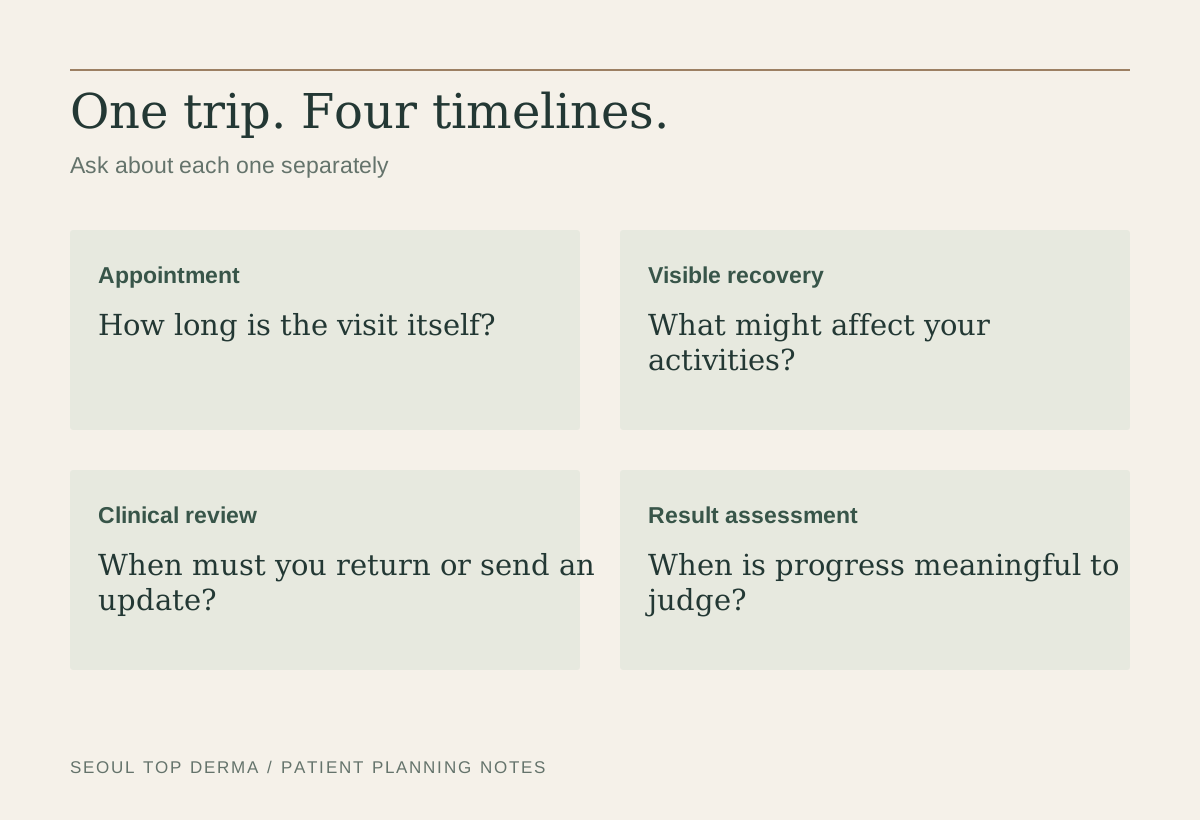
Distinguish the appointment duration, the period of visible recovery and the time needed to judge results. A short procedure does not imply that your skin will look unchanged afterward. Equally, looking comfortable enough to go outside does not mean the final result is ready to assess. Ask your clinician to explain these three timelines separately, using the proposed treatment and your own circumstances rather than a generic marketing description.
Ask what could make recovery longer, what follow-up is routine and what would require an additional in-person assessment. Write down the planned review date before arranging a tightly scheduled onward trip. If the answer is that you would need to remain nearby longer than your itinerary allows, consider postponing the procedure. A smaller or different treatment should only be chosen if it is clinically appropriate, not simply because it can be fitted between a flight and a dinner reservation.
Think through an ordinary day after the appointment. Can you reach your accommodation easily? Will you have privacy to follow the care instructions? Can you avoid activities the clinician advises against? Will you be able to obtain any prescribed products and understand their labels? These practical questions often matter more than staying near the most fashionable shopping district. Choose arrangements that support the proposed care, not a recovery plan that must adapt to every existing booking.
Ask specifically about makeup, cleansing, exercise, heat exposure, swimming and sun exposure, rather than assuming one general instruction covers all of them. Do not use a timetable from another patient's social post to decide when to restart an activity. For treatments that affect the skin surface, the care instructions may change as healing progresses. Have the clinic explain what to do on the first evening and how later instructions differ, then keep that written guidance accessible.
Make a list or take photographs of the skincare products and medicines you actually use. Include prescription creams, supplements and treatments obtained from other clinics. Ask the clinician which products to continue, pause or restart, and when. Do not stop prescribed medicines on your own to fit a procedure. If the proposed plan conflicts with advice from your usual clinician, resolve the conflict before treatment rather than trying to balance the instructions yourself.
A trip can tempt you to start several new products alongside a procedure. Keep the clinician informed about what you plan to use, including products purchased after the appointment. If irritation occurs, a clear record helps explain what changed. Ask for a written routine using product names or ingredients you can identify at home; a recommendation that only refers to the color of a bottle will not be useful once packaging or availability changes.
The American Academy of Dermatology emphasizes individualized aftercare after acne-scar procedures. That principle matters for travel planning: obtain the instructions for the treatment you actually received, rather than relying on a general website checklist. Ask which effects are expected, how long they are expected to last, and which changes require prompt assessment. Make sure you know whether a scheduled review is optional, routine or necessary before leaving.
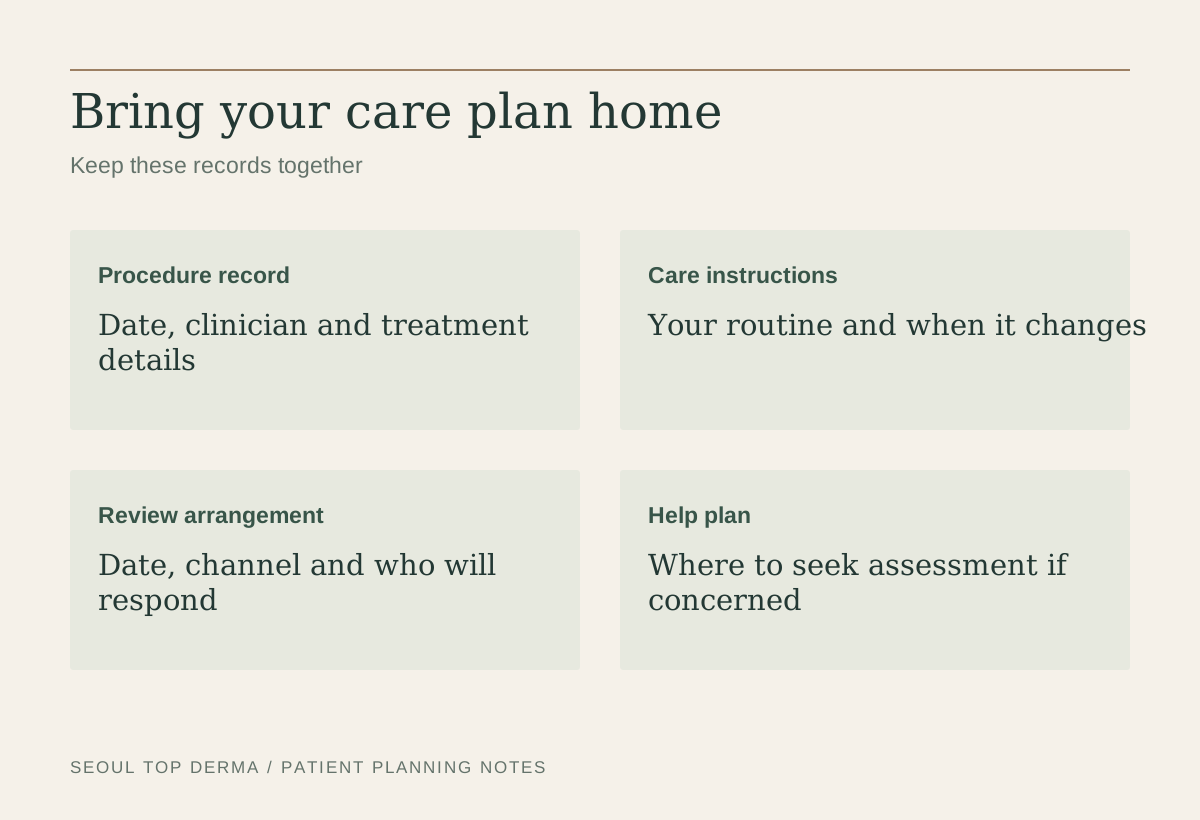
Request a treatment record that states the procedure, date, treating clinician and relevant product or device details. Ask how you can obtain additional records if another clinician needs them. Keep a digital copy that you can access without searching through an extended chat thread. If you are given medicines, keep the labeled packaging and instructions. These details support continuity of care; they should not depend on remembering everything discussed when you were tired or uncomfortable after treatment.
Ask for the clinic's ordinary contact hours and how urgent concerns are handled outside them. Clarify whether photographs sent through a messaging service are reviewed by a clinician and how quickly the clinic normally responds. Do not assume that a read receipt means a medical assessment has taken place. A remote conversation can help with some questions, but it cannot always replace an examination.
If you suspect a significant complication, seek medical assessment rather than waiting for a routine online response. CDC guidance on medical tourism advises people not to delay care when complications are suspected during travel or after returning home. Tell the clinician assessing you what procedure you had, where and when it occurred, and provide the records you received. A plan for timely help is more useful than a promise that complications never happen.
Request a quote for the entire proposed plan, separating the consultation, procedure, prescribed products and follow-up. Ask whether taxes are included and how changes after examination affect the amount payable. Do not assume an advertised promotion applies to your treatment area or circumstances. Keep the quote in the original currency and confirm how payment will be processed; currency conversion can make comparisons harder when estimates are given informally.
Set aside resources for changes in plans, including an extra visit or an extended stay if medically advised. Check your own insurance wording for elective care and possible complications rather than assuming ordinary travel cover applies. Coverage differs by policy and circumstances, and a clinic cannot determine the terms of your insurance contract. Ask the insurer directly where necessary, and keep the answer with your travel documents so you understand what you would need to pay yourself.
If a clinic recommends several sessions, ask how the intervals are determined and what progress would be reviewed between appointments. A treatment course is not just a quantity of sessions to use before departure. Ask what happens if you complete only the first step and whether continuing near home is possible. Do not buy a multi-session package until you understand the clinical schedule and the commercial terms.
For a concern that needs ongoing management, an initial assessment and written plan may be the most useful outcome of a short visit. You can ask your usual clinician to review the plan afterward, with your consent and records available. Avoid assuming another clinic will repeat a procedure exactly or accept responsibility for follow-up it did not agree to provide. Continuity needs an actual arrangement, not merely a name in your address book.
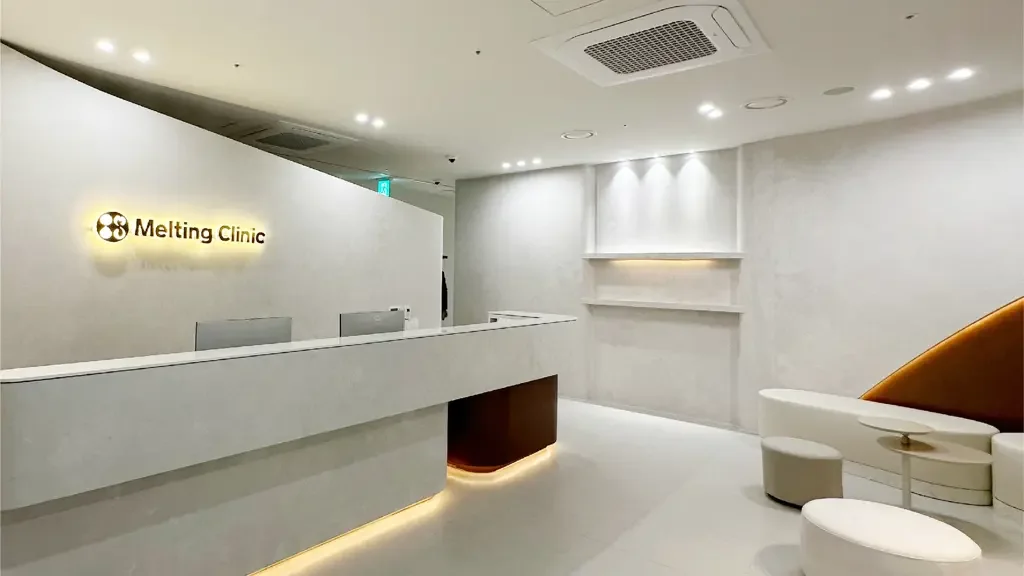
BLS Clinic Main Branch lists aesthetic laser and skin-care services and identifies Dr. Yi Dong-jin in its published team. When reviewing its international website, use your itinerary to ask which assessment and follow-up would apply to the proposed care. Seongsu Melting Clinic lists skin care and acne treatment and names Dr. Kyongmin Park, whose stated specialty is family medicine. Ask the clinic to match your concern to an appropriate appointment before deciding whether it suits a short visit.
These are relevant consultation options from the supplied provider roster, not guarantees that a particular procedure fits your stay. Both are PB-plan listings, so commercial priority should be considered separately from your clinical decision. Their official international sites are linked below. Confirm the treating clinician, communication arrangements and current appointment details directly; published services do not establish individual suitability or availability on a travel date.
Before you depart, check that you have the treatment record, current care instructions, follow-up date and contact details. Put a reminder in your own calendar for any agreed review. Ask how to send an update and what information is useful, such as photographs taken in consistent lighting or a description of symptoms. Keep the original instructions so you can distinguish a clinician's advice from suggestions found later online.
After returning home, assess progress at the time agreed with the clinician rather than judging the result every morning. If a concern needs examination, arrange it locally and share the treatment details. Your trip does not end the care process, and the distance should not make it harder to get help. A successful plan is one you can carry out before, during and after Seoul, even when that means choosing an assessment now and delaying an elective procedure until the timing is better.
Sources checked 26 October 2026. This guide is editorial information, not a personal diagnosis or an independent clinical review.
 Cheongdam · Seoul clinic
BLS Main Branch offers lifting, laser treatment, skin boosters, hair removal and facial volume procedures at its Dosan-daero location. The breadth of its menu makes a…
 Seongsu · Seoul clinic
Seongsu Melting offers acne and skin-care programs, laser treatments, lifting and injectable aesthetics at 113 Achasan-ro. Dr. Kyongmin Park is the named clinic leader. This…
Promoted PB and Scaleup listings rotate first among relevant clinics. Placement is not a clinical ranking.